
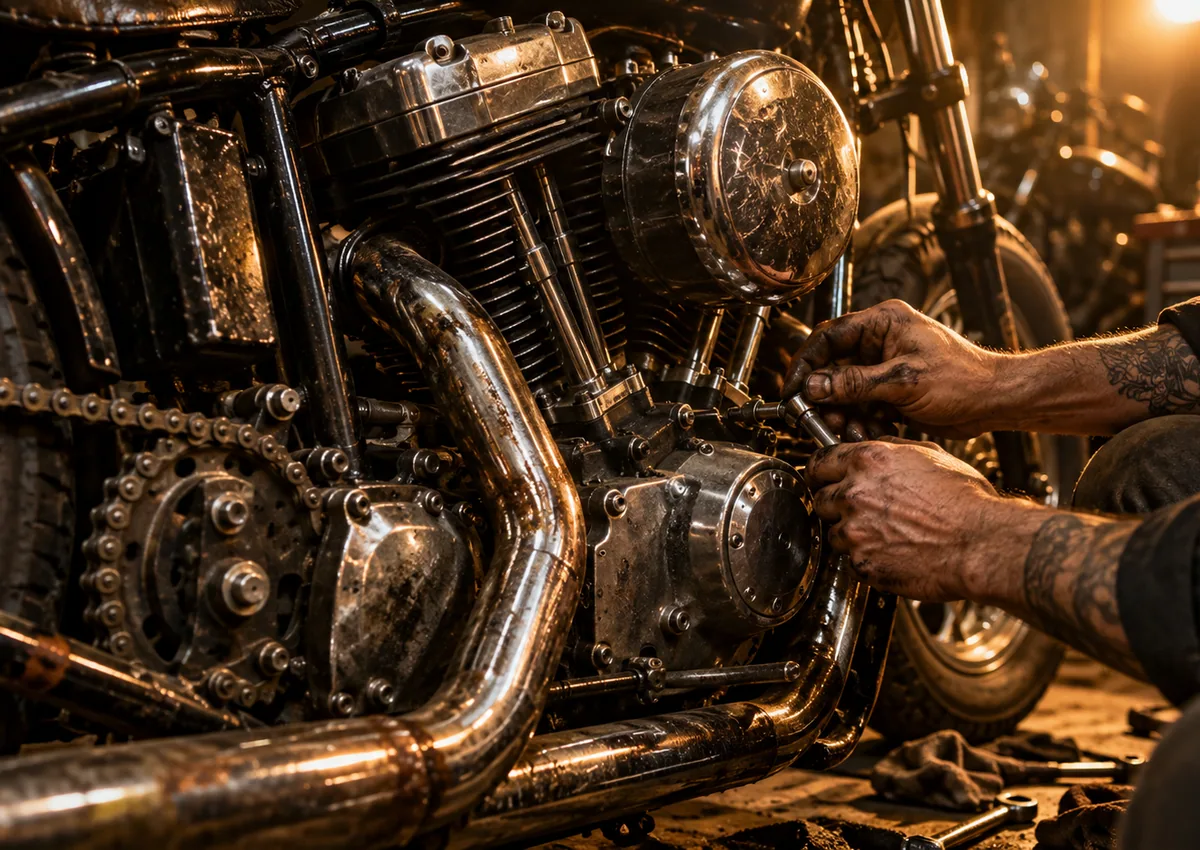
EVOLUTION: THE ENGINE, THE DESIGN AND THE REAL WORK.
The Evolution engine helped redefine Harley-Davidson reliability. The Big Twin's new aluminum cylinders and heads, improved oil control and production precision preserved the traditional 45-degree pushrod character while offering more consistent everyday performance.
Two distinct engines carry the Evolution name: the 1340 Big Twin of 1984–1999 and the Sportster Evolution family launched in 1986. They do not share the same crankcases, cam layout, gearbox design or most performance components. Never buy parts for an 'Evo' without first identifying which engine and model generation it actually is.
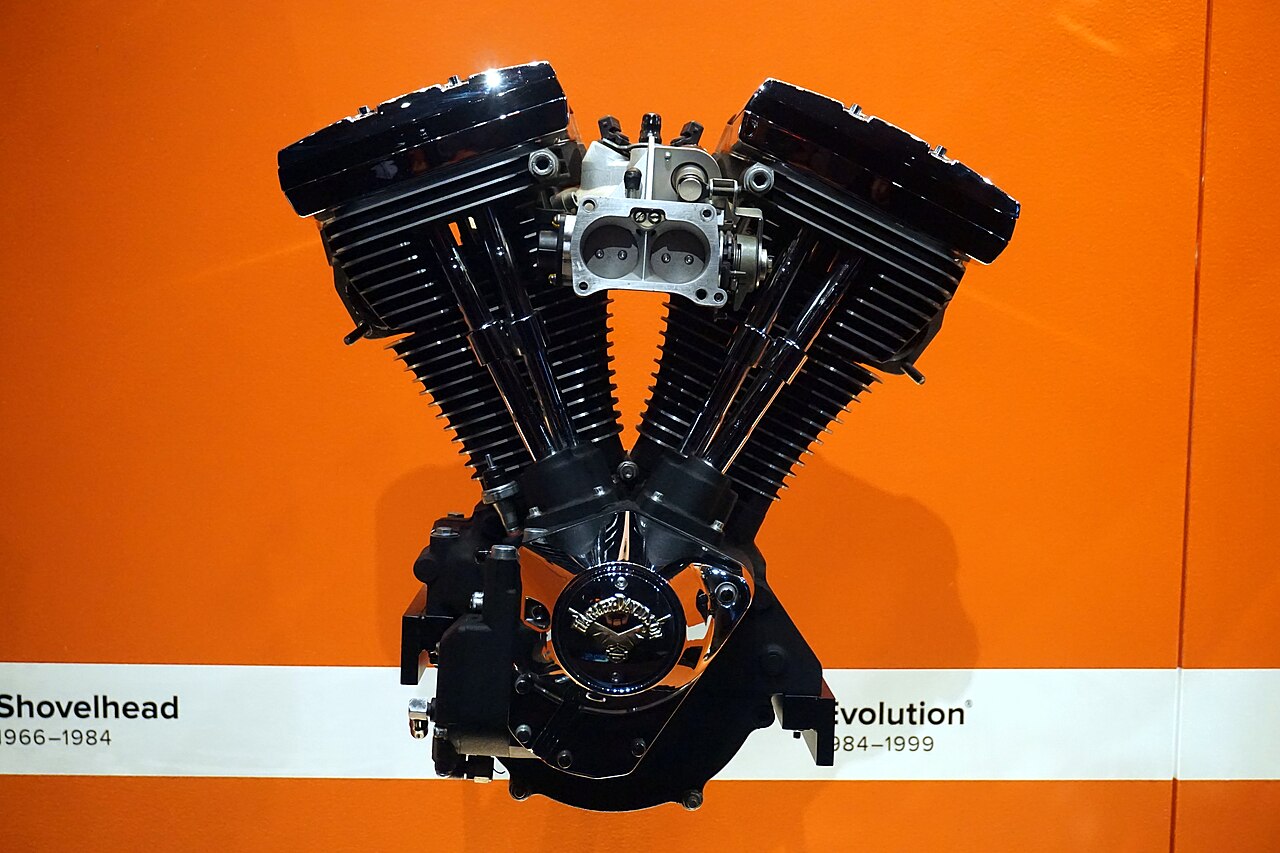
ENGINE IDENTITY
Years: Big Twin 1984–1999 / Sportster 1986–2022
Displacement: Big Twin 1340 / XL 883, 1100 & 1200cc
Architecture: Air-cooled pushrod 45-degree V-twin in historical Harley application; engine-family details vary.
Factory models changed throughout production. The correct engine serials, casting numbers, chassis and service documentation determine actual specification and part fitment.
FACTORY DEVELOPMENT TIMELINE
Historical guide1340-class Evolution Big Twin appears on selected models
Evolution Sportster engines replace Ironhead XL powerplants
Important Sportster transmission/cam family changes; check fitment
Electronic fuel injection offered in certain Evolution Touring applications
Core Big Twin Evolution era concludes as Twin Cam replaces it in mainstream models
Traditional air-cooled Sportster Evolution production era ends in the Harley model history
THE POWER AND OIL PATHS
These are conceptual illustrations only. Actual routing, valve train and lubrication differ by year and engine family; consult factory diagrams before repair.
ENGINE DESIGN AND RESTORATION
JUMP TO A SYSTEM
Big Twin Evolution: the core design
The 1340-class Big Twin retains the 45-degree air-cooled V-twin and separate traditional powertrain principles. A single gear-driven camshaft operates tappets, pushrods and overhead rocker arms. Aluminum heads and barrels represent a major material change from previous designs.
Improved manufacturing consistency and sealing became a major selling point, but no engine is immune to old gaskets, crankcase breathing problems or worn bearings. An Evo with a healthy bottom end and correct tune can be durable without chasing a large displacement number.
- Single cam on Big Twin; don't confuse with XL four-cam engine
- Aluminum heads and cylinders with pushrod OHV valve gear
- Dry-sump oil supply and return with model-specific tank/pump layout
- Engine is not universally interchangeable with Twin Cam or M8 chassis
Sportster Evolution is a different architecture
The XL Evolution is a unit-construction engine and transmission, in contrast with the separate-package Big Twin. Its crankcase arrangement, gearbox integration, valve-train parts and four individual gear-driven camshafts make it a different engineering family from the Big Twin Evolution.
The production family spans early 1100 versions and 883/1200 configurations, with major running changes. Certain years separate cam application groups; 2004 brought widespread rubber-mount chassis changes, and later fuel injection introduced another set of tuning and compatibility constraints. XL and Big Twin parts should never be mixed by name alone.
- XL four gear-driven cams versus Big Twin single cam
- Different crankcases, gearbox, primary and top-end parts
- Verify 1986–90, 1991-on and 2000-on cam-drive catalog divisions
- 883-to-1200/1275 kits demand head, piston/valve, fuel and fitment checks
Camshaft selection and the real torque curve
Cam duration, lift, lobe timing, valve spring pressure, piston-to-valve clearance and compression all interact. A cam that makes an impressive peak dyno figure at high rpm may be disappointing on a heavy cruiser at common highway rpm.
Big Twin gear-driven cam components and Sportster four-cam sets need year-specific part numbers. Use a documented baseline and choose a tested combination that reflects your bike's displacement, carb/EFI, exhaust, riding weight and intended road speed.
- Identify whether you're shopping Big Twin or XL cam hardware
- Compare torque across usable rpm, not peak horsepower alone
- Measure spring clearance and valve-to-piston safety margin
- Read maker installation instructions and match lifters/pushrods
Oil pumps, cam chest and crankcase ventilation
The Evolution uses pressure-fed dry-sump lubrication and a scavenge return system, with different packaging across the Big Twin and Sportster families. Oil pump, breather and oil-line mistakes on modified motorcycles can create real damage.
Oil leaks around rocker boxes, cylinder bases or gaskets are common inspection items on older bikes, but pressure and return problems must be separated from seepage. An engine that wet-sumps after storage may require check-valve investigation, while persistent overheating or blow-by may be rooted in ring, breather or tuning condition.
- Identify correct oil circuit for the exact engine family
- Measure mechanical condition before replacing external seals
- Verify breather routing and oil tank level under factory procedure
- Inspect tappets, lifters and cam bearings before performance upgrades
Carburetor, EFI and ignition calibration
Early Big Twin Evos used carburetors with electronic ignition. Later Touring applications introduced electronic fuel injection, while air-cooled Sportster Evos moved through carburetion and later EFI generations. A universal 'Evo tune' cannot account for those differences.
Before choosing a high-flow intake, larger carburetor or exhaust, check fuel delivery, manifold sealing, ignition timing and actual engine compression. Performance products should be evaluated with repeatable runs and logged conditions, not anecdotal throttle response alone.
- Identify carburetor vs EFI and the specific module or fuel-injection generation
- Check intake seal condition before rejetting
- Know the legal/emissions status of the modification
- Preserve baseline setup and test changes under comparable conditions
Cylinder heads, bore, pistons and big-bore packages
The Big Twin's aluminum top end permits many aftermarket combinations, but case geometry, cylinder studs, head fit, chamber volume, compression and crank/bearing capacity limit what can safely be installed. Catalog displacement claims are not substitutes for measuring your real hardware.
Sportster 883-to-1200 or larger conversions require special attention to piston-to-valve relationships, head style, ignition and fuel mapping. Manufacturer instructions warn of application-specific cam gear and head differences. A reliable upgrade is a measured combination of parts, not simply the biggest bore printed on a kit box.
- Record existing bore, stroke, combustion-chamber volume and squish
- Check gasket and stud compatibility
- Budget machine work, head service and calibration
- Verify clutch and cooling ability after raising cylinder pressure
Drivetrain and chassis context
Big Twin Evolution motorcycles appear in Softail, Touring, FXR, Dyna and other configurations, but their engine mounting, oil tank, electrical systems and gearboxes do not all match. Likewise, rubber-mounted and earlier solid-mounted XL Sportsters have different service and accessory constraints.
A road-performance build must account for clutch holding capacity, brakes, suspension spring rates, tires and overall weight. A high-output engine can make an old chassis less forgiving if the rest of the bike has not been maintained.
- Verify chassis model and year, not only engine displacement
- Check clutch slippage before selecting a stronger clutch
- Match shocks and fork springs to riding load
- Inspect tires, brakes and wheel bearings before road testing
Typical diagnosis: Evo oil leaks, noises and heat
An older Evo may exhibit rocker-box seepage, base-gasket leakage, lifter noise, rough idle, weak charging or heat under load. Each has multiple possible causes. Document whether symptoms happen cold, hot, at idle or under acceleration.
A logical diagnosis begins with the wiring and ignition, a controlled leakdown/compression check, oil circulation, crankcase ventilation, intake sealing and valve-train inspection. Avoid attributing all noise to the cam. Belt and primary problems can masquerade as engine trouble.
- Record symptoms and operating conditions
- Test charging and battery output before chasing ignition
- Verify compression and oil return
- Inspect tappet and cam condition when symptoms justify opening the chest
Building a durable performance Evo
An effective street Evo build might combine properly matched intake and exhaust, a cam selected for usable torque, correct ignition and a healthy clutch, without touching its bottom end unnecessarily. A more serious big-bore or high-compression build needs a clear mechanical and thermal plan.
Insist on a complete quote: pistons, rings, valve-train parts, bearings, gaskets, tuning, dyno, machine shop, labour and follow-up inspection. A shop claiming a power result should show the baseline, environmental conditions, fuel, all supporting changes and the entire torque curve.
- Start with a healthy baseline and clear riding goal
- Build a matched system rather than buying disconnected parts
- Budget labor, tuning and durability work
- Ask for transparent dyno methodology and service documentation
How to identify the correct Evolution before parts shopping
Look at the engine location, model family, number plates, cylinder/rocker arrangement, transmission package, carb/EFI parts and factory documents. Always record the full motorcycle model year, frame identification, engine and any aftermarket case numbers.
For a Big Twin Evo, verify 1980s/1990s model-specific service information. For an XL, check four-cam catalog applications, head and gearbox changes, frame mounts and EFI generation. This work prevents the expensive mistake of ordering a part for the wrong 'Evolution' family.
- Big Twin 1340 or Sportster XL? Identify first
- Record chassis year and engine year when they differ
- Check all cam, ignition and top-end part numbers against exact applications
- Document every aftermarket modification before ordering replacement components
ENGINE VOCABULARY
1984–1999 1340-class V2 engine with a single cam
1986–2022 Sportster unit-engine family with four cams
Constant-velocity carburetor used in many Evo-era applications
Valve opening/closing events relative to crankshaft position
Compressed-air test helping locate sealing loss when properly performed
SOURCES, FACTORY LITERATURE & CREDITS
Engine dates, architecture and historical changes were checked against manufacturer and technical historical sources. This researched guide does not imply WTN has disassembled or dynamometer-tested this particular museum engine. Exact torque settings, machining tolerance, electrical wiring and oil flow must come from correct factory literature and professional inspection.
- https://www.harley-davidson.com/us/en/content/expert-advice/history-harley-davidson-engine-types.html
- https://www.harley-davidson.com/us/en/content/expert-advice/harley-davidson-sportster-history.html
- https://www.andrewsproducts.com/sites/default/files/assets/SportsterCams_86-later.pdf
- https://serviceinfo.harley-davidson.com/
NOVEMBER 2026 / WTN WORKSHOP ADDENDUM
Evolution — Advanced Mechanic’s Inspection File
Big Twin 1340 (1984–1999) and separate Sportster XL Evo (1986–2022): practical system checks, identification risks, and recordkeeping for preservation and road reliability. Consult current factory and replacement-part technical sources before any safety-critical work.
Evolution mechanic’s note 1 — Big Twin and Sportster Evo are separate families
The 1340 Big Twin uses a different crankcase and driveline arrangement from the Sportster unit engine, and the XL architecture carries different camshaft, transmission, oiling and primary-drive hardware. Never use a Sportster camshaft, 883-to-1275 conversion procedure or primary fluid quantity as a Big Twin instruction. Confirm engine by VIN and part number.
Evolution mechanic’s note 2 — Cylinder-head and sealing inspections
An Evolution aluminum top end can still suffer incorrect head gasket, base seal, rocker cover or intake-manifold installation. Prioritize clean surfaces, stud threads, correct gasket generations, proper pushrod geometry and correct oil return paths. If a base gasket leaks, verify crankcase breathing and cylinder condition rather than just tightening fasteners.
Evolution mechanic’s note 3 — Cam selection and valve-train geometry
Big Twin Evolution has a single-cam architecture; Sportster Evolution uses a distinct multi-cam design. For a Big Twin cam swap check lifter, spring, pushrod and rocker compatibility, compression, exhaust and available torque range. For an XL, verify cam gear timing, inner gear alignment and the exact 883/1200 model revision.
Evolution mechanic’s note 4 — Ignition, carburetor and EFI variants
An Evolution may use Keihin/CV carburetion, aftermarket carburetors or model-specific electronic fuel injection. Identify ECU/ignition module and sensor architecture before selecting ignition advance or jetting. Verify intake seals, float height, battery/charging and timing data before ordering coils, carburetor kits or a fuel programmer.
Evolution mechanic’s note 5 — Sportster 883-to-1200/1250/1275 planning
Conversion is not a generic bolt-on across all XL years. Record actual head type, chamber shape, piston crown, cylinder studs, compression, ignition/cam compatibility, balancing, chassis/transmission generation and fuel delivery. Follow the chosen kit maker’s precise machining, ring gap and torque requirements. Cost includes calibration, tools, head work and post-install validation.
Evolution mechanic’s note 6 — Crankshaft and breathing health before big bore
Oil-control problems can come from breather condition, ring sealing, oil feed/return or worn cylinders. Record hot symptoms, leak-down, compression, oil level and actual bore before planning pistons. A proposed big-bore is not a repair for a failing bottom end or a poor crank assembly.
Evolution mechanic’s note 7 — Two-up road-test and restoration record
Log final drive ratio, clutch slip, braking, stable highway RPM, valve-train noise, fueling, hot idle and overnight leaks. Retain photos of seals/rockers, installed cam grind, jets or ECU file, and calibration notes in the motorcycle’s service file.
Shop record template
Frame VIN / case stamps: ____________________ Engine casting: ____________________ Bike year & trim: __________
As-found parts and historical alterations: _____________________________________________________________________
Symptoms and measured diagnostic results: _____________________________________________________________________
Factory manual / kit instruction revision: _____________________________________________________________________
Work performed / installed part numbers: _____________________________________________________________________
Hot verification / road test / follow-up: _____________________________________________________________________
Measurement policy: None of these notes supplies universal torque or clearance numbers. Wear limits and procedures vary by model year and replacement hardware. Obtain the correct factory service manual from Harley-Davidson’s service portal, current kit instructions and applicable repair bulletins. WTN’s descriptions are researched reference material, not firsthand engine tear-down test reports.
For later generations use the Twin Cam workshop guide and Milwaukee-Eight service guide.
WHITE TRASH NETWORKS / THE GARAGE
BUILT TO RIDE. RECORDED TO LAST.
WTN workshop files for the people keeping American iron on the road.
WTN WORKSHOP FIELD FILE / NOVEMBER 2026
EVOLUTION / TOP-END STACK & XL CAMS
Use this file alongside the engine chapters above. The following diagnostic and documentation workflows are WTN editorial guidance; published component requirements are linked by name.
Keep Big Twin and Sportster build sheets separate
Start with the case and head identifiers, actual displacement, cam part number and ignition/fuel system. An Evolution nameplate does not identify one common parts set. Make a second column for non-stock components so a later mechanic can see where factory fitment ends.
For a cylinder kit, pair each piston with its measured cylinder, retain the piston maker’s gauge-point instructions and record ring gaps by cylinder and ring position. A box labelled with the right capacity is not evidence that every clearance has been checked.
Treat the top end as a measured stack
HAMMER’s squish guide shows why deck height, cylinder height, rod length, piston height and gaskets all contribute to the assembled result. Measure both cylinders with the intended parts and assembly method. Keep the results at different positions rather than recording only the most convenient measurement.
Changing gasket thickness to alter clearance also changes the assembled stack and compression calculation. Re-check the related valve-train dimensions after a change; a single dimension should not be corrected in isolation from the rest of the build.
XL cam checks beyond the peak-lift number
HAMMER’s Sportster cam guide separates clearance near overlap from maximum-lift clearance elsewhere. Record the checks applicable to the selected cams: piston/valve, valve/valve, retainer/seal, spring travel, rocker enclosure and cam-box clearance. The required values come from the exact combination, not a universal “Evo safe” number.
Keep the manufacturer’s checking-height convention with the cam card. Two cams with similar advertised lift can differ in valve position around top dead centre. A head shop needs the actual cam specification before preparing the heads.
Finish the job file with the final head work, gasket stack, pushrod choice, measured clearances and calibration. If the motor is sold later, those records tell the next owner far more than its claimed horsepower.
Primary references: HAMMER Performance: checking squish · HAMMER Performance: XL cam installation and clearances · Harley-Davidson Service Information Portal. WTN research notes checked 17 November 2026; examples below are explanatory, not recorded WTN test results.